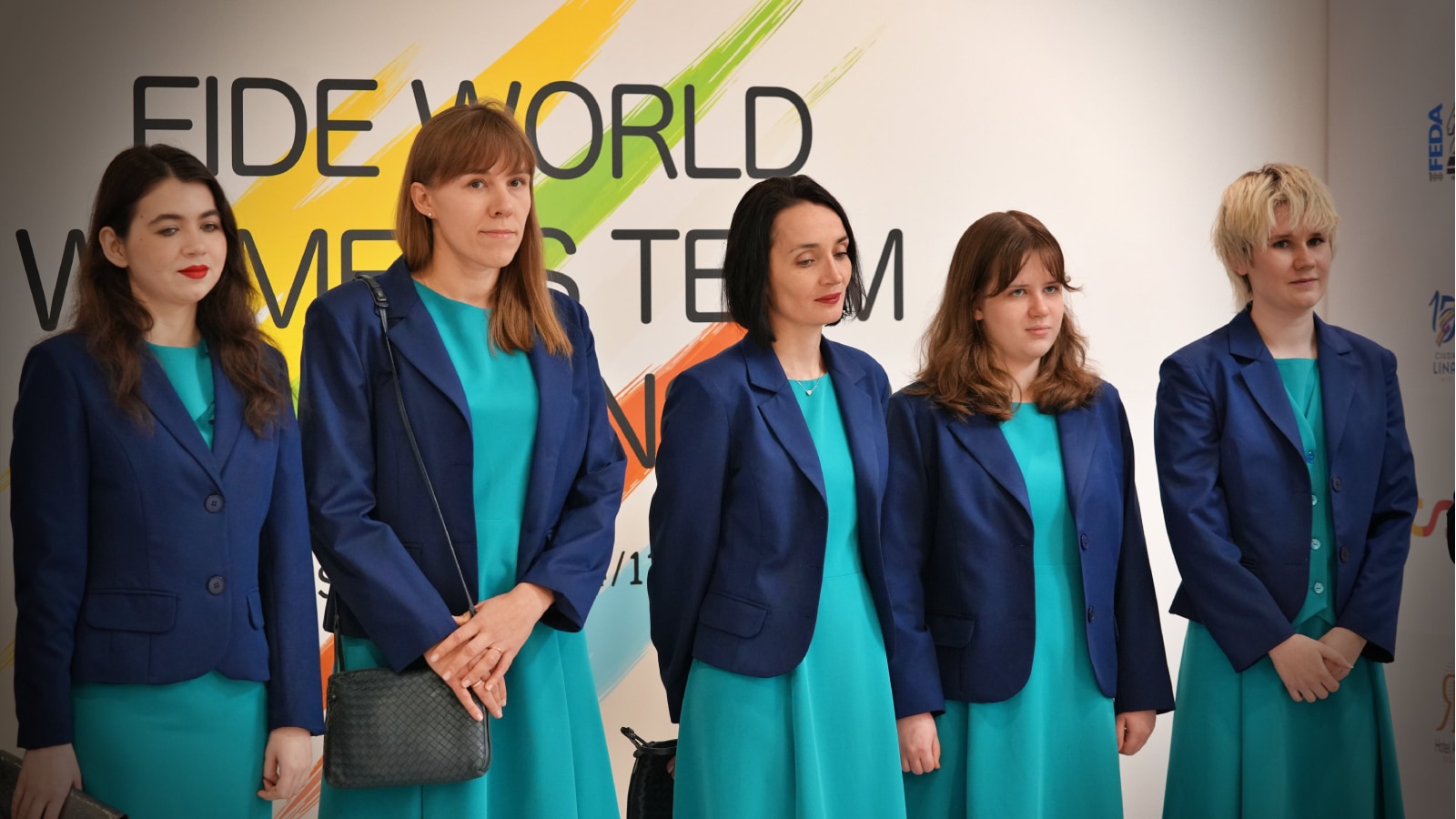
Moscow – The Russian women’s chess team has emerged victorious at the World Team Championship, sparking celebrations and bold claims from the Russian Chess Federation (RCF). The victory, however, arrives amidst continued scrutiny and restrictions placed on Russian athletes due to the ongoing conflict in Ukraine.
Competing under the neutral banner of FIDE (International Chess Federation) due to sanctions, the Russian team defeated Azerbaijan in the final to secure the gold medal. China claimed the bronze. The tournament, a biennial event akin to the Chess Olympiad, saw the Russian women reclaim the title they last won in 2021. They were absent from the 2023 edition due to FIDE’s ban on Russian teams following the invasion of Ukraine.




Alexander Tkachev, Executive Director of the RCF, seized upon the victory to assert Russia’s supremacy in the chess world. “It’s been proven once again: if we’re allowed anywhere, we always take first place,” Tkachev declared, as quoted by Russian news agency TASS. “We haven’t lost a single match, which proves that the Russian chess school is currently the strongest in the world. And no matter what obstacles they throw in our way, no matter what interviews they give admitting they’ll do everything to deprive Russians of chess, nothing will work. The girls have shown how to resolve all issues at the chessboard, not behind the scenes.”
The Russian team comprised of strong players like Aleksandra Goryachkina, Kateryna Lagno, Polina Shuvalova, Leya Garifullina, and Anna Shukhman. Several team members also secured individual medals for their performance on their respective boards: Polina Shuvalova (gold on board three), Leya Garifullina (silver on board four), and Anna Shukhman (gold on board five).

While Russia celebrated, other teams also had notable performances. The Indian women’s team, however, faced disappointment, losing to Kazakhstan in the quarter-finals. Significantly, none of India’s four grandmasters – Koneru Humpy, Harika Dronavalli, Vaishali Rameshbabu, and Divya Deshmukh – were part of the squad. India was instead represented by IM (International Master) Padmini Rout, WGM (Woman Grandmaster) Nandhidhaa PV, WIM (Woman International Master) Velpula Sarayu, IM Savitha Shri B, and WGM Srija Seshadri.
Despite the team’s overall performance, individual Indian players secured recognition. Padmini Rout claimed an individual bronze medal on the top board, and Savitha Shri B earned a bronze on the fourth board for Team India.




The absence of top-ranked Indian players raises questions about the team selection strategy and its impact on India’s chances in the tournament. Meanwhile, Azerbaijan’s silver medal represents a significant achievement for their chess program, solidifying their position as a rising force in international chess.
The World Team Championship victory serves as a morale boost for Russian chess amidst the ongoing geopolitical tensions. Tkachev’s assertive statements underscore the RCF’s determination to maintain its dominance in the sport, despite the restrictions and criticisms leveled against Russian participation in international events. The success under the FIDE flag allows Russian players to continue competing and showcasing their talent on the world stage, while also fueling national pride at home.
However, the controversy surrounding Russian participation continues to cast a shadow. Critics argue that allowing Russia to compete, even under a neutral flag, provides a platform for the nation to project soft power and distract from the conflict in Ukraine. This debate is likely to persist as long as the geopolitical situation remains unresolved, raising complex questions about the role of sports in international relations and the balance between individual athlete opportunities and broader political considerations.
The victory, therefore, is not simply a chess triumph; it is a complex narrative intertwined with political implications and ongoing debates about the place of Russia in the international sporting community.